From Shop Fronts to Spare Rooms: The Quiet Conversion Trend Reshaping Brighton's High Streets
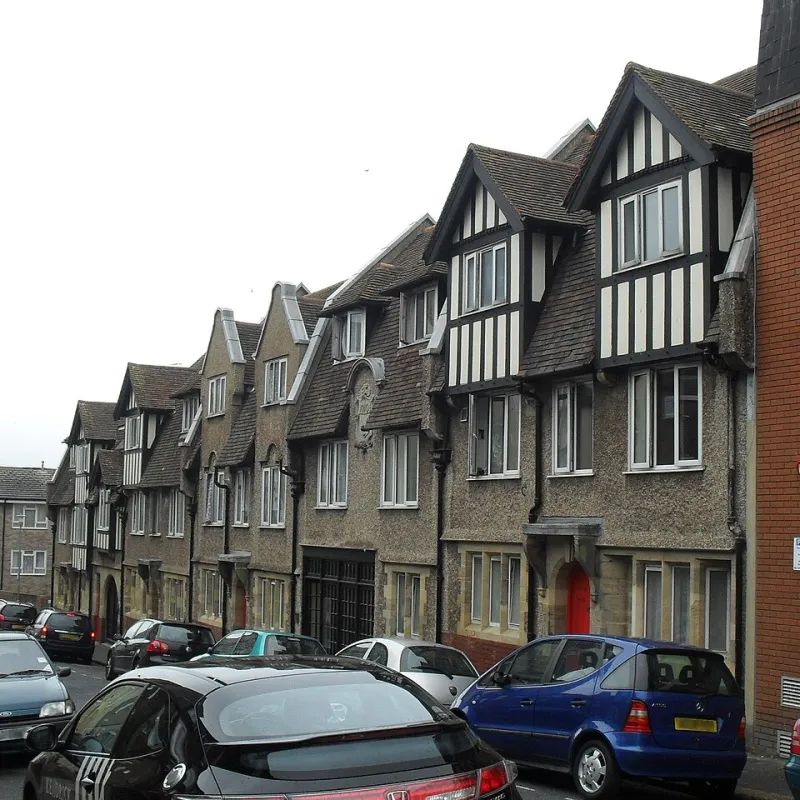
Photo: The Voice of Hassocks, Public domain, via Wikimedia Commons
Walk down certain stretches of Brighton's side streets these days and you'll notice something odd. What used to be a picture framer's workshop, a small rehearsal studio, or a neighbourhood café now has net curtains in the window and a wheelie bin outside. The signage is gone. The A-board is gone. What remains is, unmistakably, a flat.
This isn't accidental. It's a deliberate financial strategy — one that's quietly accelerating across the city, and one that's leaving businesses with fewer and fewer options when it comes to finding affordable, long-term premises.
The Maths Behind the Move
The logic isn't hard to follow, even if the consequences are uncomfortable. A mid-sized commercial unit in Hanover or Kemptown might fetch somewhere between £800 and £1,200 per month on a commercial lease — if a tenant can be found at all, and if that tenant doesn't spend the first six months negotiating a rent-free period. Convert the same footprint into a two-bedroom flat, and you're looking at upwards of £1,800 a month in the current Brighton market, with far less hassle, far shorter void periods, and a tenant pool that's genuinely enormous.
For landlords sitting on commercial properties that have struggled since 2020, the residential route isn't just appealing — it's starting to feel inevitable.
"I kept the unit commercial for nearly three years after my last tenant left," says one landlord who owns a ground-floor space near London Road and asked not to be named. "I genuinely wanted a business in there. But I couldn't hold out forever. My mortgage didn't care that the commercial market was slow."
He applied for change of use under permitted development rights — a process that, since government reforms in 2021, has become significantly easier for landlords to navigate — and within months had a residential tenant paying considerably more than any commercial occupier had offered.
What Businesses Are Up Against
For small businesses trying to find space in Brighton right now, the shrinking commercial stock is a very real problem. It's not just that rents are high (they are). It's that suitable units are increasingly rare, and when they do come up, they tend to be snapped up quickly or priced at a level that only well-capitalised operators can sustain.
Sophie, who runs a small ceramics studio and teaching space, spent eight months looking for a new unit after her previous landlord sold the building. "I had a very clear idea of what I needed — ground floor access, decent ceiling height, somewhere I could make a bit of noise without it being a problem. That used to describe half the arches and light-industrial units in Brighton. Now it describes almost nothing I can actually afford."
She eventually found something — a shared arrangement with another maker — but describes the process as "genuinely frightening" and says she knows several other creative businesses who gave up entirely and relocated out of the city.
This kind of displacement is increasingly common. And while individual stories vary, the underlying pressure is the same: commercial space in Brighton is contracting, and the businesses that depended on it are being squeezed out.
The Planning Picture
Brighton and Hove City Council is not unaware of this dynamic. The authority has, in recent years, sought to use Article 4 Directions — planning tools that remove certain permitted development rights in defined areas — to protect commercial land in parts of the city. The idea is to prevent landlords from converting commercial units without full planning permission, giving the council more say over what happens to the city's employment land.
In practice, though, these protections are patchy. They apply in some areas and not others, and they don't address the underlying economic pressure that makes residential conversion so attractive. A planning restriction can slow the process down; it can't make commercial tenancies more financially competitive than residential ones.
A council spokesperson, when asked about the trend, acknowledged the challenge: "We recognise that the loss of commercial floorspace is a concern for the local economy and for the vitality of our town centres. We continue to review our planning policies to ensure that employment land is protected where appropriate."
It's a measured response to what many business owners would describe as an urgent problem.
The Storage Dimension
There's a related issue that doesn't always get discussed: when businesses lose their premises, they don't just lose a place to work. They lose their storage. Workshop stock, equipment, display materials, archive boxes — all of it suddenly needs to go somewhere.
For businesses in transition, self-storage can provide a genuine lifeline. It's not a substitute for a proper commercial unit, but it does allow a business to keep operating in some form while it searches for new premises, or to mothball equipment rather than selling it off at a loss. In Brighton's current climate, where the search for commercial space can stretch to months or longer, that kind of flexibility matters.
It also speaks to a broader truth about how businesses in the city are adapting: doing more with less, finding creative workarounds, and refusing to fold even when the conditions are stacked against them.
A City at a Crossroads
Brighton's identity has always been bound up with its independent spirit — the small galleries, the makers, the niche retailers, the slightly eccentric service businesses that give the city its character. That identity doesn't survive without physical space to inhabit.
When commercial units become residential flats, they don't come back. Once a space is converted, the economics of reversing that decision are almost never in anyone's favour. What's lost to the city's commercial landscape tends to stay lost.
That's the part of this story that goes beyond individual landlords making rational financial decisions. In isolation, each conversion is understandable. In aggregate, they represent a slow erosion of something that Brighton has long taken for granted: the idea that if you wanted to start something here, there'd be somewhere to start it.
Whether that changes depends on policy, on investment, and on whether the city decides that protecting its commercial ecosystem is worth the effort. Right now, the evidence on the ground suggests the answer is uncertain — and the conversions are continuing regardless.